
Walk into most enquiries for industrial bulk packaging and the drawing that comes back is a four-panel bag. It is the default shape, it is well understood, and for a large share of applications it is entirely adequate. But default and correct are not the same thing, and a number of buyers end up managing problems that come from the shape itself rather than from the fabric, the supplier or the price. This article looks at what a circular bag - round body, round bottom - actually changes, where that change pays for itself, and where it does not.
What the construction changes
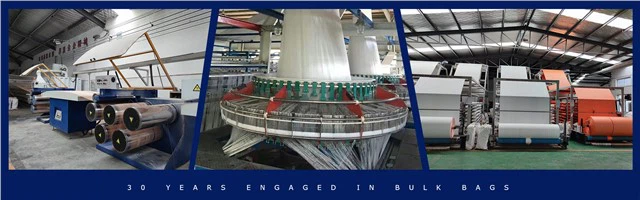
A circular bulk bag is woven as a tube. The body therefore has no vertical seam joining two flat faces, and it is closed on a round bottom rather than by a seam running across the base. The bag is, in the literal sense, one continuous cylinder of fabric with a base and a top.
Two things follow immediately, and they are structural rather than cosmetic.
The first is that the bag has no internal corners. A four-panel construction creates four vertical edges inside the load, and anything that does not flow freely will settle into them. The second is that the number of joints in the highest-stress region - the base - goes down. A bulk bag rarely fails across the middle of a panel; it fails where the load transfers, and every joint removed from that region removes one place where the load must pass through stitching rather than through continuous fabric.
Where this matters commercially
Residue is the most common reason buyers move to a circular bag, and it is usually discovered after a problem rather than before one. In a four-panel bag, product rests in four corners that gravity alone will not clear. If the material is a fine powder, a pigment, a food ingredient or anything with a hygiene specification, those corners are the difference between a bag that empties and a bag that has to be cleaned before it can be re-used - or, if it is single-trip, between a bag that goes to waste disposal and a bag that goes to waste disposal with product still inside it. In operations that change batches frequently, the corner is also where documentation gets awkward: a residue is a cleaning validation question, and cleaning validation is expensive.
Discharge behaviour follows the same logic. A round body consolidates around a single low point, so the material moves toward the outlet in a single direction instead of dividing between four faces. This does not solve every flow problem - cohesive powders can still bridge over an outlet, and that is a question of outlet geometry and material behaviour rather than of bag shape - but it removes the class of problem caused by corners holding product back.
Sifting and sealing are the second commercial reason. A coated or laminated fabric reduces transmission through the weave, but it does not eliminate the routes through seams. A circular body has fewer vertical seams to begin with, and a round bottom has no linear seam across the base. Where the material is moisture-sensitive, dusty, or simply expensive enough that a slow loss matters, fewer joints is a shorter list of places where the packaging can leak it.
The third reason is the liner, and it is the one buyers most often overlook. Where a bag is lined, the liner is doing the protective work and the bag is only carrying it. A tubular liner inside a round body has nothing to fold around: it enters, sits and fills without being gathered into corners, so it is less likely to twist during filling and less likely to be drawn out with the discharge. Most liner failures happen in the space between the liner and the bag rather than in the film itself, and a bag shape that agrees with the liner shape removes a good part of that risk.
What a circular bag does not do
Honesty is worth more here than enthusiasm, because a circular bag is not a universal improvement and buyers are poorly served by being told it is.
A circular bag wastes space. Four-panel bags fill a pallet footprint and a container cross-section efficiently; a cylinder leaves the corners of the envelope empty. For a dense material where the constraint is weight, that is irrelevant - the bag reaches its rated load long before it runs out of room. For a light, bulky material where the constraint is volume, it is a real cost, because you are shipping air at freight rates and paying for it in container slots.
Print is the second compromise. A four-panel bag offers large flat faces, which suit detailed artwork, regulatory blocks and multi-language information. A circular body carries print on a curved surface, and layout has to be designed for that rather than adapted to it afterwards.
The third compromise is handling familiarity. A round bag rolls and settles differently on a pallet, and stacking behaviour is not identical to its square equivalent. That is manageable, but it should be planned rather than discovered in the warehouse.
How to decide
The sequence that produces a correct answer is short, and it starts with the material rather than with the bag.
Establish whether the application is weight-limited or volume-limited: fill weight divided by bulk density tells you which constraint governs, and it decides whether the wasted corner volume of a cylinder costs you anything. Then look at how the product behaves: free-flowing materials are forgiving of shape, cohesive ones are not, and materials that leave residue in a corner will do so consistently. Then look at the handling path - how the bag is filled, where it is discharged, whether it travels once or ten times, and who cleans it between products. Only then does shape become a decision rather than a preference.
For buyers evaluating a circular bag, three checks are worth the effort. Ask for a sample in the fabric you will actually order, not a lighter demonstration fabric. Fill it with your material and discharge it under the conditions of your own plant, because discharge behaviour in a supplier's warehouse tells you very little. And if the bag is lined, confirm how the liner is fixed and how it behaves at the outlet, because a liner that is clamped only at the outer spout can twist during filling and be pulled out at discharge.
A bulk bag should be specified from the product it carries and the way that product is handled. Shape is one of the variables, not a house style. Circular construction is the correct answer for a meaningful set of applications, and it is the wrong answer for another set - the value is in knowing which one you are in before the order is placed rather than after the first batch has been filled.
For enquiries: office@heshengbulkbag.com
WhatsApp +8619333177097
https://www.hs-bulkbags.com/

