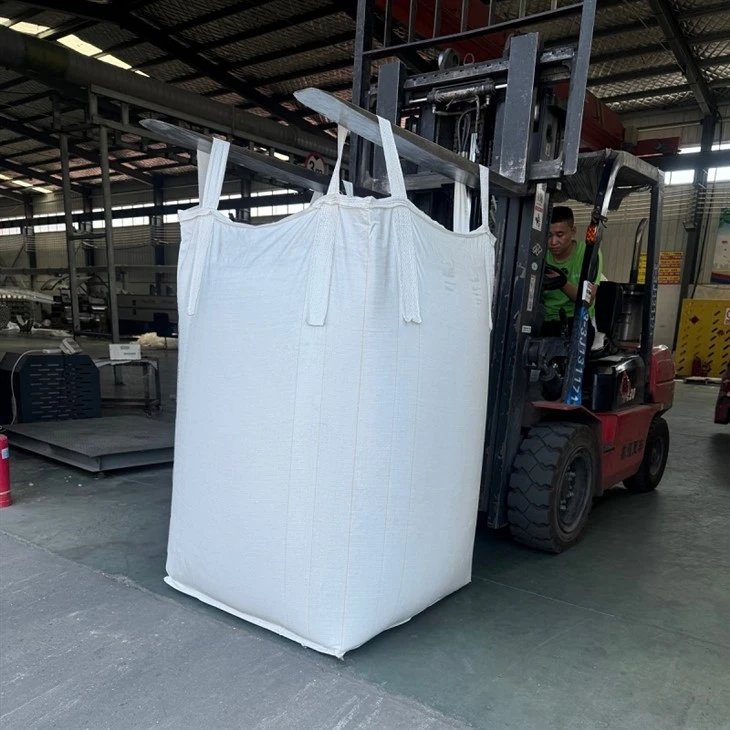
Not long ago, choosing an FIBC was mainly a conversation about fabric weight and price per unit. That conversation is changing. Procurement teams handling dry bulk materials increasingly arrive at suppliers with a technical questionnaire, a request for batch-level documentation, and a list of failure modes they have already seen in the field.
The reason is straightforward. Global demand for dry bulk packaging keeps expanding, with industry projections placing the segment at up to USD 8.8 billion in 2026, and with that growth comes a larger pool of suppliers willing to quote a bag that was never engineered for the application. For buyers, the risk has moved from availability to specification.
Start with the material, not the bag
The selection sequence should begin with what is going inside. Bulk density decides whether a nominal 1,000 kg load will even fit the footprint under consideration, and it is the figure most often assumed rather than measured. Flow behaviour determines whether the bag needs a full discharge spout, a conical base or nothing at all. Moisture sensitivity decides whether an internal liner is adequate or a barrier structure is required. Abrasiveness and particle shape set the fabric construction. Temperature and any solvent content narrow the choice further.
One question must be answered before any of this: is the material classified as dangerous goods for transport? If it is, the bag is a certified packaging with its own test regime, and specification follows that route. If it is not, ISO 21898 governs the design, testing and marking of the bag. Applying the wrong framework invalidates every decision made after it.
Match the safety factor to the risk
Safety factor is the ratio between a bag's minimum breaking strength and its rated safe working load. Single-trip bags are generally tested to 5:1, meaning a bag rated at 1,000 kg has demonstrated a breaking strength of 5,000 kg. Multi-trip bags require 6:1, reflecting accumulated stress from repeated filling, handling and discharge. Some specifiers call for 8:1 where hazardous or especially high-value material is involved.
The margin exists to absorb dynamic forces - the sudden stop of a forklift, a swinging load, uneven filling - not to license overload. Raising the safety factor also raises material cost and bag weight, so it should be matched to the actual risk profile rather than maximised by default.
Ask what was tested, and on which bag
This is where the buying conversation has shifted most. The current edition of ISO 21898 is the 2024 revision, which tightened cyclic top lift procedures, clarified stacking test duration and expanded guidance on UV ageing validation. Buyers are now asking suppliers to show how the rating was produced rather than accepting a figure. The relevant evidence includes a cyclic top lift test in which the filled bag is repeatedly lifted and lowered, a stacking test in which the bag carries a compressive load equivalent to the bags that would sit above it for a minimum of 24 hours, a drop test from a height of 0.8 to 1.2 metres onto a hard surface, and for outdoor applications a UV ageing test confirming the fabric retains a defined share of its original tensile strength after exposure equivalent to the claimed service life, commonly taken as at least 50 percent for periods in the order of three to twelve months.
Four details are worth checking on any certificate. Whether the laboratory is accredited and can be verified through its accreditation body. Whether the certificate names the specific bag design, fabric specification and production batch rather than a generic type. Whether the test date is recent enough to reflect current production. And whether photographic documentation of the test setup exists.
Several shortcuts recur and are worth naming. A certificate showing fabric tensile strength with no completed bag test, on the reasoning that fabric strength equals bag strength. Cyclic tests run at reduced load. Drop tests conducted from lower heights than the standard requires. UV performance asserted from the percentage of stabiliser added rather than from exposure testing. Any of these is a reason to ask more questions before placing an order.
Treat static classification as an operating decision
Where combustible dust or flammable vapour is present, the static classification of the bag is not a technicality. Under the industry classification aligned with IEC 61340-4-4, bags are grouped from Type A, which offers no static protection, through Type D, which dissipates charge without a ground connection. Type C depends on the conductive path being earthed during filling and discharging. Choosing the bag and choosing the procedure are therefore the same decision: a correctly specified bag used without grounding is not a safe installation.
For food, feed and pharmaceutical cargo, cleanliness is a specification
For inquiries, samples or bulk orders, please contact us at: Email: office@heshengbulkbag.com