
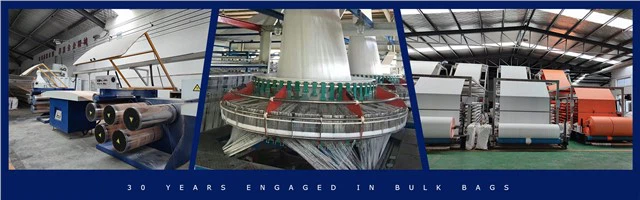
When you hear about "big white bags," the first thing that comes to mind is just some kind of packaging, a rough-hewn container for bulk materials. Many people think so, especially those who haven't worked directly with production. But in reality, if you dig deeper, it's a whole engineering process, where the choice of bag can determine logistics, product safety, and even security. I experienced this myself when looking for options for shipping mineral powder-it seemed like I could take any, but no.
Not just a "bag": construction and materials
Look. The main material is, of course, polypropylene. But if you just pick any old one, you can run into problems. Density, weave method (woven or not), lamination or liner-every detail serves a specific purpose. For food products, for example, you need a large white bag with pure raw materials and often an additional barrier layer to prevent fats or flavors from escaping. For construction mixtures, tensile strength and moisture resistance are more important; other additives come into play here.
Speaking of sizes, standard 50-kilogram bags are just the tip of the iceberg. I've also encountered large white 1-ton sacks, so-called "big bags." They require a completely different lifting system-reinforced slings are needed for specific loops. I once saw movers hook one "somehow," the bag ruptured, and half a ton of polymer granules spilled across the site. Cleanup, lost time, and wasted raw materials. So, loop design is no small matter.
Where and how do they actually work?
The main industries, of course, are agriculture (fertilizers, animal feed), construction (cement, gypsum, dry mixes), and the chemical industry (polymer granules, mineral fillers). But there are also less obvious applications. For example, in the recycling industry, crushed plastic or textiles are often packaged in such bags for temporary storage and transportation.
Compatibility is key here. Not every polypropylene is suitable for aggressive chemicals. There was an incident at one of the factories: they began packaging an intermediate chemical product with high residual acidity. Bags that had held the fertilizers well began to lose strength at the points of contact after a week. They had to urgently test options with inert inner linings. This goes to show that there is no universal solution-you always need to look at the material data sheet and, ideally, conduct your own tests.
Another important aspect is logistics and warehousing. A properly designed large white bag has good dimensional stability and can be stacked. But if the seams are weak or the bottom is not reinforced, the lower rows of bags on the pallet will simply collapse. We once received a batch where the manufacturer skimped on the seam thread. When forming the third tier on the pallet, the bottom bags split along the seam. This resulted in further losses. Now we always pay attention to the quality of the stitching and the presence of additional reinforcing tape on the bottom.


