
Ask for a one-tonne bulk bag and three quotations arrive, all appearing to describe the same object. They rarely do. The phrase conceals two independent decisions that are usually made in the wrong order, by different people, and one of them is almost never written down.
The first decision is how the body is joined. The second is how the bag is lifted. Neither is a preference. Both are engineering consequences, and a quotation that names only one of them is not a comparable quotation.
Where the seams go
Every bulk bag body is woven polypropylene fabric joined into a container. What separates the constructions is where the joins are, and how many.
A circular, or tubular, body is woven as a tube on a circular loom. There are no vertical seams at all - only the top and the base are attached. For fine powders this is the significant advantage, because a seam is a path and fine material finds paths. The cost is dimensional: a tube bulges as it fills, so the filled shape is rounder and less predictable than a bag assembled from flat panels, which matters if the bag has to sit neatly inside a container or a racking bay.
A U-panel body uses three pieces. One long panel forms the base and two opposite sides - the U - and two further panels are sewn in to close the remaining sides. That gives two side seams and, notably, no seam running across the base, which is where the load sits. The result fills into a squarer shape than a tube, and it is the reason this is the most widely used general-purpose construction.
A four-panel body is four side panels joined at the four corners. It holds its shape best of the flat-panel constructions, because every corner is a seam doing structural work. It also has the most seams to control, which is precisely the wrong trade for a fine, free-flowing powder and often the right one for a product that has to stand square and be counted by eye.
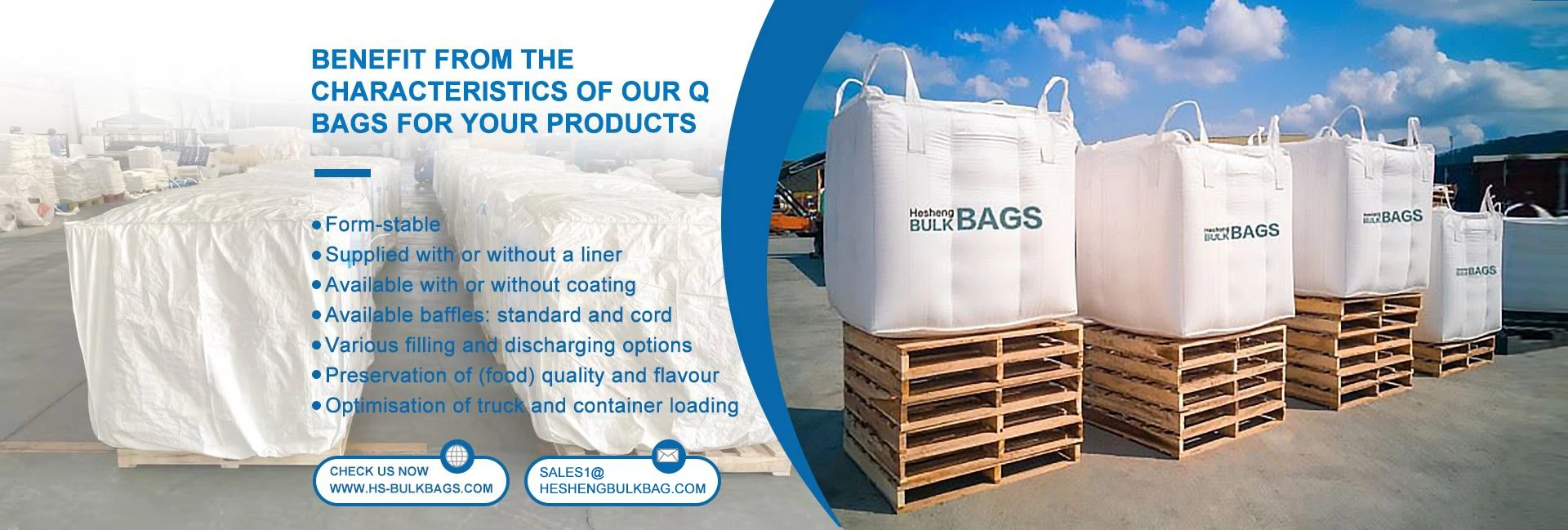
A baffle, or Q-bag, goes further: additional fabric panels are sewn inside each corner so that the bag cannot round out when filled. The filled bag keeps a square footprint, which means adjacent bags sit flush against each other, stacks are more stable, and the fixed space of a container or a warehouse bay is used more completely. The price is a more complex build. There is also a detail buyers discover late: at the same external dimensions, a baffled bag does not hold the same volume as an unbaffled one, because the corners have been pulled in to achieve the square shape.
Read together, these four options describe one trade-off. A seam is simultaneously a line of reduced strength and a potential sifting path. Constructions that minimise seams favour fine powders. Constructions that maximise shape control accept more seams in exchange for a bag that stacks. There is no version of the bag that gets both without a cost somewhere else.
How the load gets carried
The second decision is not part of the body at all, and it is the one that gets lost in a one-line enquiry.
Four corner loops place one loop at each top corner, so forklift tines pass through all four. It is the default in most warehouses and the reason it is the default is equipment, not strength.
Cross-corner loops are sewn across the corner seam so that the lifting force is shared by two panels rather than acting on one attachment point. For heavier fills and frequent handling, that distribution is the point.
One-loop and two-loop bags gather the body or the straps into a single point or a pair, so a hook or a crane can lift the bag. They suit high-volume lines handling one product repeatedly, and they require the handling equipment to be set up for them.
Belt and bottom-support designs run lifting belts down the body and cross them under the base, so a heavy, dense load is carried from below rather than suspended from the top corners.
The point worth stating clearly, because it is a common misreading: fewer loops does not automatically mean a weaker bag. Strength is a property of the fabric, the loop attachment, the sewing and the rated load and safety factor the design was tested to - not of the loop count. What the loop count changes is the distribution of force and the equipment the bag will work with.
Tops and bottoms are a third decision
Filling and discharge are usually chosen separately from body and lifting: open top, skirt, filling spout, conical or flap top above; flat base, discharge spout, conical or full-open below. A bag can be structurally excellent and still be wrong because it cannot be filled from the customer's hopper in the time available, or because emptying it requires cutting it open over a pit.
The practical consequence
Two suppliers can quote against the same one-line request, both be correct, and both be describing different products. The specification that separates them is the panel layout and the lifting method - and those are exactly the items usually absent from a request that says "one-tonne bag".
The fix is short. A usable enquiry names four things: the body construction or, if unknown, the constraint driving it (fine powder, fixed footprint, stacking height); the lifting equipment and the loop configuration it requires; how the bag is filled; and how it is emptied. Everything else - fabric weight, coating, liner, printing, safety factor - follows from those four, and can be quoted without guesswork.
Buyers who specify the body and forget the loops end up with a bag that fits the product and not the forklift. Buyers who specify the loops and forget the top end up with a bag that fits the forklift and not the filling line. In a market where the fabric is broadly similar, the construction is where the difference actually lives.
For inquiries, samples or bulk orders, please contact us at: Email: office@heshengbulkbag.com

