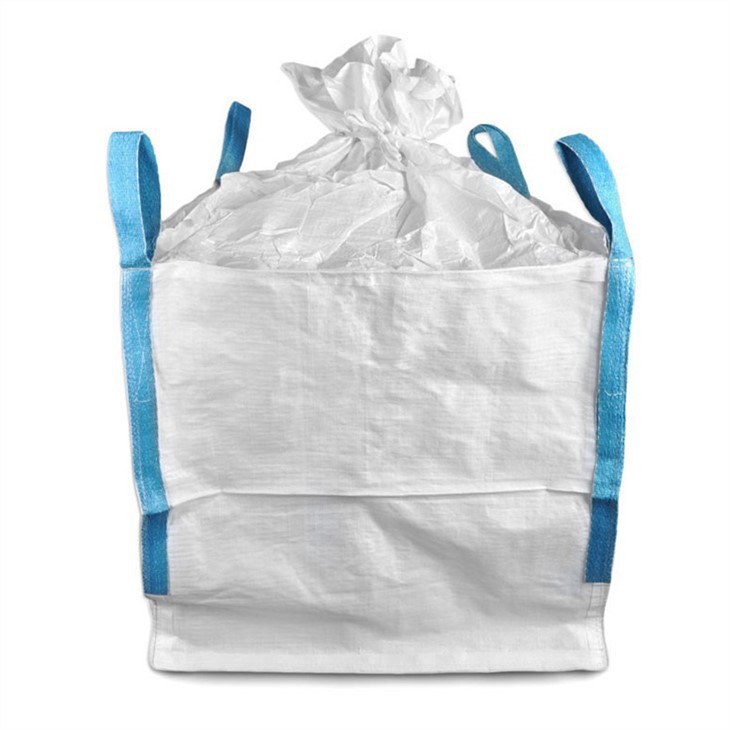
For most of the past three decades, the bulk bag was a single category in search of a single answer: what is the cheapest bag that will carry this material without splitting?
That question still governs a large part of the market, and it is the right question for wheat, fertiliser, cement, sand, minerals and plastic granules. But a second family of applications has grown up alongside it, in which the bag is not judged on cost per tonne at all. It is judged on whether it protects a material whose value collapses if the packaging lets anything in.
The two families use the same physical product - a woven polypropylene bag with lifting loops - which is exactly why buyers keep benchmarking them against each other and getting nonsense results.
The commodity family: the bag is a handling device
In commodity applications, the cargo is tolerant. Grain can take a season of ambient humidity. Cement does not care about a trace of dust. Plastic granules are washed before they are processed. What matters is throughput and cost per tonne moved, and the bulk bag earns its place by replacing a slower or more expensive alternative: twenty-five kilo sacks that need a person at each end, steel drums that cost more to return than to buy, rigid intermediate bulk containers that occupy the container cube even when empty.
In this family, the specification has been stable for years. A four-loop bag in a standard construction, a working load that matches the filling line, and a safety factor matched to whether the bag makes one trip or several. The variables are price, lead time and print. Buyers negotiate hard, and they should - the differences between competent suppliers here are real but marginal.
The specification-critical family: the bag is part of the process
Then there are applications where the packaging is effectively the last unit operation of the production process. Battery materials are the clearest example, and the fastest-growing one.
Consider lithium hydroxide. It is moisture-reactive and reacts with atmospheric carbon dioxide to form lithium carbonate, which is a different compound with a lower value and a different specification. A bag that is merely waterproof in the ordinary sense is not sufficient; the inner surface has to be a reliable barrier and the liner has to be sealed shut after filling, so the system is closed rather than merely covered. Where cumulative exposure across a long sea transit is a concern, a desiccant is added inside the liner.
Or consider the anodes. Natural and synthetic graphite, silicon-based materials and hard carbon are fine powders, and they are electrostatically sensitive. That moves the conversation from cost per tonne to static classification and grounding discipline - and it moves it into territory where a mistake is not a commercial loss but an ignition risk.
Or consider black mass, the recovered powder from battery recycling. It is simultaneously a fine powder, an electrostatically sensitive material and, in a growing number of jurisdictions, a regulated one. A bag for black mass may need to satisfy an electrostatic classification and a certified transport design at the same time, from the same piece of packaging.
The same logic appears, less dramatically, in food ingredients, where the binding constraint is usually foreign-matter control rather than moisture: the places where a bag can introduce contamination are the spout, the liner seam and the discharge, and those are the places a price-driven specification never examines.
Why quotes differ by multiples
A buyer who collects quotes for a grain bag, then collects quotes for a lithium hydroxide bag, and concludes that the second set is inflated, has misread the comparison. Four things change, and each one is a cost.
The liner system. At one end, no liner. At the other, a multi-layer barrier with documented chemical compatibility against the material's safety data sheet, heat-sealed after filling.
The closure. An open top tied off is not the same as a sealed system, and the difference is a machine, a process step and a validation.
The static classification. A conductive bag is a construction, not a label, and it requires a continuous path and a grounding procedure at the customer's site to mean anything at all.
Certification. A certified transport design is a tested design, produced and marked under a quality system, and the documentation has to match the batch rather than the catalogue.
Add port handling - crane lifts, stevedore straps, multiple transfers between ship, yard and truck - and the mechanical margins move too, which is usually where a higher safety factor enters the discussion.
The practical consequence
Before comparing prices, establish which family the cargo belongs to. The question is not "what does a bulk bag cost" but "what does this cargo require the bag to do".
A short test: if the packaging fails, does the cargo survive? For sand and cement, largely yes - you sweep it up. For battery-grade lithium hydroxide, no. The material is downgraded, rejected or lost, and the loss is measured in tonnes rather than in bags.
That single question sorts most enquiries correctly, and it saves a fortnight of quotation ping-pong between suppliers who were never really bidding on the same item.
The bulk bag industry has spent years explaining that the bag is more than a sack. The application split is where that claim finally becomes measurable: two customers can order an identical-looking bag, and only one of them is buying packaging. The other is buying a guarantee about what is inside it.
For inquiries, samples or bulk orders, please contact us at: Email: office@heshengbulkbag.com