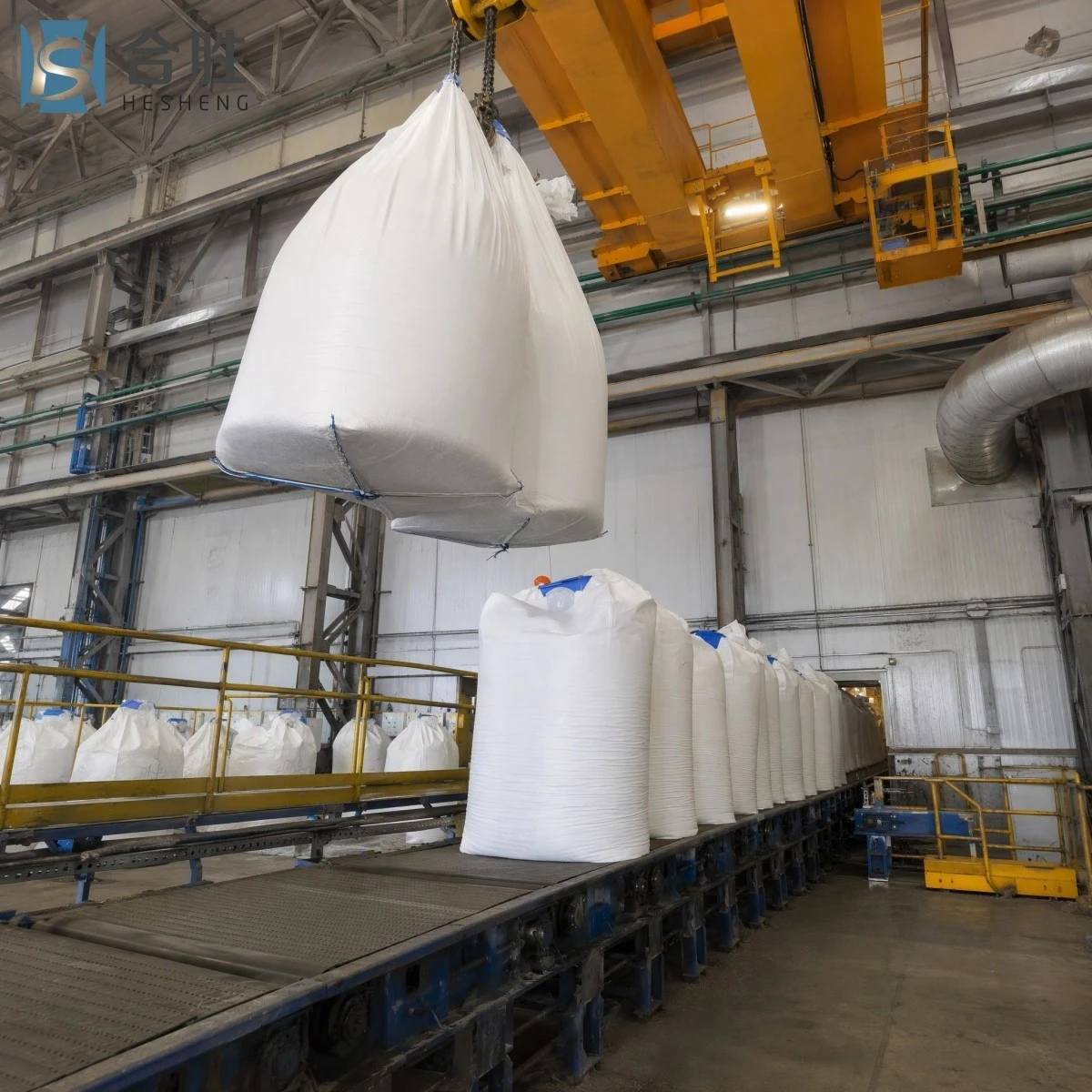
A single loop bulk bag - the one-point lifting bag, often called a one-loop bag - is not a variation on a standard four-loop bag. It is a different answer to a specific handling situation, and the buyers who get good service out of one are the buyers who understood that before they ordered.
The situation is common enough. Material has to be discharged into a hopper, a reactor, a mixer or a vessel; there is a single hook or hoist above that station; and there is no room, and no reason, to bring a forklift to the bag. In that layout, four loops are a rigging problem. One loop is a solution: the bag is taken with the hook that is already there, positioned over the inlet, and emptied.
This article looks at the questions buyers ask most often about single loop bags, and at the answers that tend to matter after the first delivery rather than before it.
The load path is the whole design
On a four-loop bag the load is shared between four attachment points distributed around the body. On a single loop bag the entire mass is transferred through one attachment at the top. That is not a detail of construction; it is the design premise, and everything above the fabric has to be built around it.
Two practical consequences follow. First, a single loop bag should be specified as a single loop bag. Taking an existing four-loop design and adding a central loop leaves the top assembly carrying a load it was never dimensioned for, and the top is exactly where the consequences would appear. Second, the questions worth asking are all about the parts above the bag's body: how the loop is attached, what reinforces the top panel, whether the attachment is sewn, and whether the same specification is repeated on every bag in the order rather than only demonstrated on the first one.
Buyers who ask those four questions get useful answers. Buyers who ask only for a load rating get a number and no information.
The lifter is the other half of the system
A single loop bag is inseparable from what lifts it, and this is where projects fail for reasons that have nothing to do with the bag supplier.
The hook, hoist or spreader has to be rated for the load, and its throat has to be shaped so that it does not concentrate force on a narrow band of the loop. A worn hook, a hook that is too small for the loop width, or an improvised shackle will damage the loop on the first lift, and a lifting loop cannot be repaired afterwards. Single loop bags also have a natural freedom to rotate under a single point, which is helpful for positioning over an inlet and unhelpful if the bag is not controlled during the lift.
None of this is the bag maker's decision, but it is the bag maker's problem if the interface is never discussed. A supplier who asks what will lift the bag, and whether the hook has been inspected recently, is doing the job properly.
The discharge side decides whether the bag is actually convenient
Most single loop bags exist because the material goes into a fixed inlet. That makes the outlet a matching problem rather than a component choice: a spout that fits the inlet, an iris or a full-open bottom where the process needs flow control, and a length that lets the operator reach the connection without standing under a suspended load.
Dust is the second consideration at this end. Filling and emptying into a fixed vessel concentrates the dust cloud at the connection point, so where the material is fine or hazardous, the venting arrangement matters as much as the outlet geometry. A bag with a well-chosen outlet and no vent will still make a mess.
The liner, where one is used, changes the same area again: a liner that is not fixed properly will be drawn toward the outlet as the bag empties, and the operator will end up holding it back with one hand while the other hand works the closure. That is a design decision to settle at order stage, not an operator skill to be developed on site.
Where a single loop bag is the wrong choice
Honesty is more useful than a sales argument here.
A single loop bag is not a warehouse bag. It is designed for a handling path that starts and ends in one place, under a hook. Where bags have to be stacked, moved by forklift, loaded into a container or handled by several different people across a shift, four loops remain the more practical arrangement, and a single loop bag pushed into that role will be dragged, propped and loaded in ways it was never built for.
It is also a poor choice where the lifting equipment varies. If the hook changes, or if different shifts use different devices, a bag designed around one interface becomes fragile in practice, because the interface is the part most likely to be improvised.
Verification worth the effort
For buyers, the checks that prevent most disappointment are procedural rather than technical.
Ask for a sample in the specification you intend to order, not a lighter demonstration version. Fill it with your own material under your own conditions and lift it with the equipment that will actually lift it - a bag that behaves over a test weight on a supplier's floor tells you very little about behaviour over your inlet. Confirm how the liner is fixed if the bag is lined. And ask what happens if something goes wrong: a supplier who answers with a process, rather than a percentage, has thought about the product.
Finally, put the five facts in the enquiry rather than discovering them at commissioning: fill weight, bulk density, what lifts the bag, what it discharges into, and whether the bag travels or stays at one station. Those five lines decide the top assembly, the outlet, the liner fixing and the material, and they cost nothing to send.
A single loop bag is a simple product with a concentrated risk. The bag itself is uncomplicated; the interfaces at both ends are not, and that is where a project succeeds or fails. Specify it as a system rather than as a bag, and the simplicity becomes an advantage instead of a surprise.
For enquiries: office@heshengbulkbag.com
WhatsApp +8619333177097
https://www.hs-bulkbags.com/